
Blog Article
Your Browser's AI Assistant Is Now a Security Surface
CVE-2026-0628 exposed a high-severity flaw in Chrome's Gemini AI panel that let malicious extensions hijack cameras, microphones, and local files without asking permission. This is the new threat model nobody is ready for.
Category
Agentic Security
Author
Capxel Security Research
Reading Time
6 min read
Author
Capxel Security Research
Capxel Security editorial briefings
Published March 12, 2026 with a reading layout optimized for leaders, analysts, and operators.
A high-severity security vulnerability in Google Chrome was patched this week that should change how every security leader thinks about AI deployment.
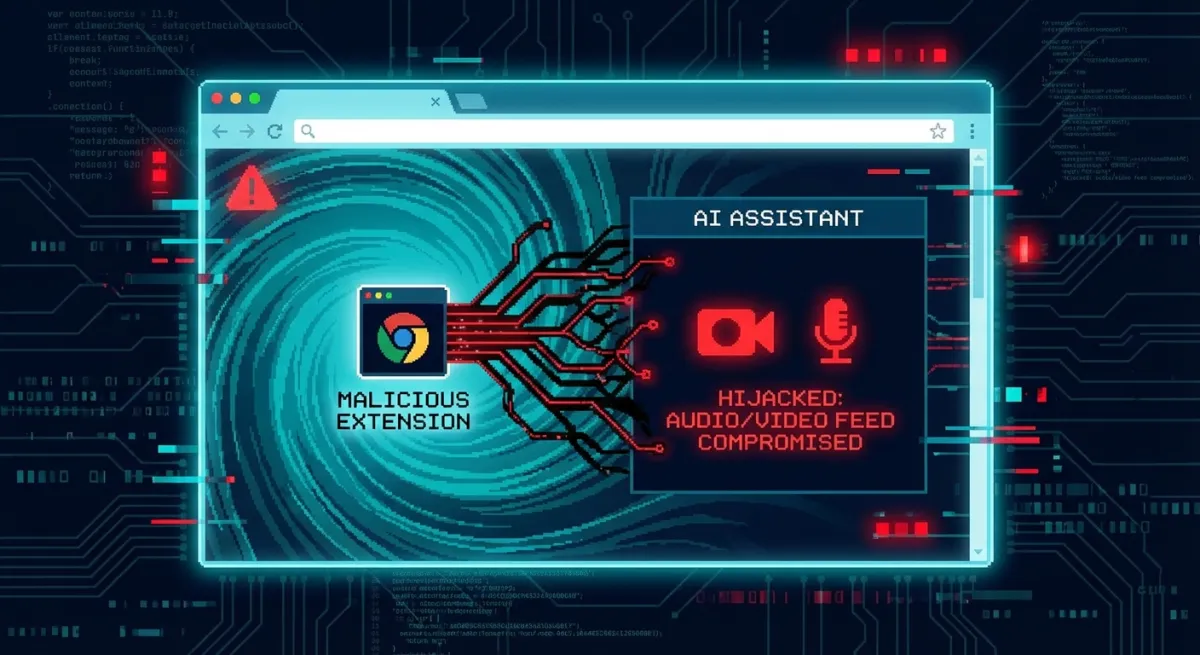
The flaw, CVE-2026-0628, was discovered by Palo Alto Networks' Unit 42 and affected Chrome's "Live in Chrome" panel — the embedded Gemini AI assistant that runs as a privileged side panel directly within the browser. CVSS score: 8.8.
The attack vector: a browser extension using a standard Chrome API called declarativeNetRequest could tamper with traffic to the Gemini panel while it loaded in its privileged context. Because the Gemini side panel is a trusted part of Chrome itself — not a third-party tab — it holds permissions that normal browser components never get. It can read local files. Take screenshots. Access cameras and microphones. Automate tasks on behalf of the user.
A malicious extension with basic, low-level permissions could inherit every one of those capabilities. No new consent prompt. No visible warning.
In practice, an attacker could: activate your camera and microphone silently, browse your local file system, screenshot every website you visit, and transform the Gemini panel into a phishing interface designed to steal credentials.
Google shipped the patch in early January 2026. Anyone running a fully updated Chrome is no longer exposed. But users who delayed updates — particularly enterprise environments with managed update policies — remain at risk until they upgrade.
Why This Is Different From a Normal Browser Vulnerability
Traditional browser vulnerabilities exploit the separation between tabs, between extensions, and between the browser and the operating system. Security teams have spent years building around these known boundaries.
The Gemini flaw broke a different boundary entirely: the line between a passive AI assistant and an active system agent.
Here's the architectural reality of modern AI-embedded browsers. Gemini Live in Chrome isn't just a chatbot in a panel. It's an AI agent with elevated OS permissions, running continuously, trusted by the browser as a first-party component. When researchers found that a low-permission extension could hijack it, they weren't just exploiting a bug — they were demonstrating that the AI layer in your browser has become an attack surface that traditional security models don't cover.
This is the same pattern appearing across enterprise AI deployments. The AI component gets elevated access because it needs elevated access to be useful. Then it becomes the most attractive single point of entry for an attacker, precisely because of that access.
Microsoft Edge embeds Copilot with similar deep integration. Google has Gemini. AI-powered browser assistants are becoming the default feature layer in every major browser. Each one is an agent with OS-level permissions running continuously in the background of every user's session.
The Broader Pattern: AI Components Becoming Attack Surfaces
CVE-2026-0628 isn't an isolated incident. It's the first major documented case of an AI model embedded in a consumer application being weaponized as an attack vector — but it won't be the last.
The pattern follows a predictable progression:
Phase 1: AI capability ships embedded in trusted application (browser, productivity suite, CRM, communication tool). Elevated permissions granted because the AI needs them to function. Shipped fast; security model updated later.
Phase 2: Security researchers identify that the AI component's elevated access creates a novel attack surface. Traditional security tooling — which monitors behavior, checks permissions, and flags anomalies — wasn't designed to monitor an AI agent operating at this privilege level.
Phase 3: Attacker discovers they can leverage the AI component's trust and permissions without triggering existing detection mechanisms. The AI itself becomes the vector, not just a tool used by an attacker.
CVE-2026-0628 is Phase 2 becoming Phase 3. We're at the inflection point.
This week alone: Microsoft patched 84 vulnerabilities in Patch Tuesday, including two actively exploited zero-days. Google patched the Gemini Chrome vulnerability. Atos launched "Sovereign Agentic Studios" explicitly because enterprise organizations can't safely deploy AI agents without governance infrastructure. The Pentagon is extending Anthropic's AI tools beyond their phase-out period specifically because AI systems have become mission-critical — which means they've also become mission-critical attack targets.
What Security Leaders Should Do Now
1. Treat embedded AI components as privileged agents, not features.
Every AI assistant embedded in your enterprise browser, productivity suite, or internal tool should be assessed with the same threat model you'd apply to a human employee with elevated system access. What can it access? What can it do? Who has visibility into its behavior?
2. Audit your browser extension posture.
CVE-2026-0628 was exploited via a low-permission browser extension. Most enterprises don't maintain a strict extension allowlist. If you can't answer "what extensions are running in your users' browsers?", you can't assess your exposure to this class of attack.
3. Accelerate your AI update cadence.
Google shipped the patch in early January. It's mid-March and enterprise environments with managed update cycles may still be running unpatched versions. The gap between "patch available" and "patch applied at scale" is a critical exposure window. AI-component vulnerabilities need to be treated with the same urgency as OS-level zero-days — because they now carry OS-level risk.
4. Rethink your detection model.
Traditional endpoint security tools detect behavioral anomalies in applications and users. They are not instrumented to detect an AI assistant accessing files it shouldn't, activating hardware without prompting, or serving manipulated content within a trusted browser panel. Your detection stack has a blind spot the size of the AI layer.
5. Apply zero-trust principles to AI components.
Every AI component in your environment should be assumed to be potentially compromised and scoped accordingly. Least-privilege access. Behavioral monitoring. Anomaly detection. The same controls you'd apply to any privileged identity — because that's exactly what an embedded AI assistant is.
The Core Lesson
Security has always been a game of attack surface management. You identify where exposure lives, you reduce it where possible, and you monitor what you can't eliminate.
AI-embedded applications have added a new category of attack surface that most security teams haven't fully mapped yet. Not the AI model itself. Not the cloud API it calls. The AI component as a local privileged agent running continuously inside trusted applications, with access to hardware, files, and user sessions — and with security boundaries designed for a pre-AI architecture.
CVE-2026-0628 is the first prominent proof of concept. It won't be the last.
The organizations that get ahead of this understand that AI security isn't just about securing the model. It's about understanding every context where an AI agent operates with elevated trust — and applying the controls accordingly.
Capxel Security provides AI agent intelligence and security infrastructure for enterprise environments. For a security assessment of your AI agent deployment and embedded AI exposure, contact us at intel@capxelsecurity.com.
Related Articles
Keep the briefing window open.
More Capxel Security analysis on AI-native threats, enterprise controls, and operator-grade intelligence workflows.
The $100K Problem: Enterprise Threat Intelligence vs. Mission-Specific Intelligence
Enterprise threat platforms cost $100K+ per year and monitor everything, everywhere. Most security teams need intelligence for specific destinations, specific dates, and specific operational windows. The market has a gap.
Continue ReadingWhat Goes Into an Intelligence Brief
Eight intelligence layers, eleven data sources, one branded brief. Here's what the Intelligence Brief actually sweeps — and why each layer matters for operational awareness.
Continue ReadingWhy Static Advance Reports Aren't Enough
Advance reports are essential. But the operating environment isn't static. Between production and principal arrival, the threat surface shifts. Here's how to close that gap.
Continue ReadingNewsletter
Want more briefings in this format?
Subscribe for new Capxel Security analysis on agentic security, enterprise controls, and premium intelligence workflows.
Work With Capxel Security
Need a product briefing after reading the analysis?
Capxel Security can route you into DOSXIER, Advance Reports, or an AgentSec evaluation when you're ready for a deeper conversation.